
Men’s Health and the Gut Microbiome: Why the Gut Matters More Than We Think
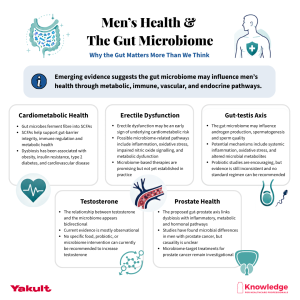
Men’s health is often discussed through cardiovascular disease, metabolic health, sexual function, fertility, testosterone and prostate conditions. Increasingly, research suggests that the gut microbiome may intersect with each of these areas through metabolic, immune, vascular and endocrine pathways. While this evidence is promising, its strength varies considerably, and many proposed microbiome–health relationships remain associative rather than causal.
Key takeaways
- The gut microbiome may intersect with men’s health through metabolic, immune, vascular and endocrine pathways.
- The strongest clinical relevance currently lies in cardiometabolic health, where microbiome function overlaps with established risk factors.
- Links with erectile dysfunction, fertility, testosterone and prostate cancer are promising but remain largely associative or early-stage.
- For now, supporting dietary patterns that benefit microbial function and broader cardiometabolic health remains the most practical approach.
How might the microbiome influence cardiometabolic health?
Cardiometabolic health provides one of the clearest and most clinically relevant links between the gut microbiome and men’s health. Gut microorganisms ferment certain dietary fibres to produce metabolites such as short-chain fatty acids (SCFAs), which are involved in intestinal-barrier integrity, immune regulation, glucose metabolism and appetite signalling. Microbial metabolism also influences bile acids and other circulating compounds relevant to metabolic and cardiovascular health.1,2
At the same time, reduced microbial diversity and function have been associated with obesity, insulin resistance, type 2 diabetes and cardiovascular disease. These relationships are complex and bidirectional: metabolic disease can alter the intestinal environment, while diet, medication use, physical activity, sleep and other lifestyle factors may influence both the microbiome and disease risk.1-3 For clinicians, the microbiome is therefore best understood as one component within a broader cardiometabolic picture rather than an independent cause or diagnostic marker.
Could erectile dysfunction reflect a gut–vascular connection?
Erectile dysfunction is not only a sexual health concern. Normal erectile function depends on healthy vascular, neurological and endocrine systems, and persistent erectile dysfunction may be an early sign of underlying cardiometabolic disease. The Princeton IV Consensus recommends considering men with erectile dysfunction to be at potentially increased cardiovascular risk until they have been appropriately assessed.4
Emerging research suggests that gut dysbiosis may contribute to erectile dysfunction through systemic inflammation, oxidative stress, impaired glucose and lipid metabolism, altered hormonal signalling and reduced endothelial nitric oxide availability.5 Together, these processes may impair the vascular relaxation and penile blood flow required for normal erectile function. However, current evidence is largely based on observational, mechanistic and preclinical studies, so causality has not been established.
From a dietary perspective, patterns rich in vegetables, fruit, legumes, wholegrains, nuts, seeds, fish and unsaturated fats may support both vascular and microbial health. Increasing plant-food diversity and fibre intake can promote SCFAs production, while reducing excessive saturated fat and highly processed foods may support gut-barrier integrity and lower systemic inflammation. 5 These strategies are best presented as part of cardiometabolic risk management rather than as stand-alone treatments for erectile dysfunction.
Microbiome-directed therapies, including probiotics, faecal microbiota transplantation, engineered microbes and bacteriophage-based approaches, have also been proposed.6 However, evidence in erectile dysfunction remains preliminary, and no specific microbial profile, probiotic strain or intervention has been validated for clinical use. Larger, standardised and longer-term trials are needed before microbiome-based therapies can be integrated with conventional erectile dysfunction management.
What is the gut–testis axis, and why does it matter for fertility?
The emerging gut–testis axis describes a bidirectional relationship between the intestinal microbiome, reproductive hormones and testicular function. Gut microorganisms and their metabolites may influence androgen production, spermatogenesis and sperm maturation, while testosterone may also shape the intestinal environment and microbial composition.7, 8 Diet, metabolic health, medication use, environmental exposures and lifestyle behaviours may further modify this relationship.
One proposed pathway begins with gut dysbiosis and impaired intestinal-barrier integrity, which may allow bacterial endotoxins and inflammatory mediators to enter the circulation. Systemic inflammation and immune activation may then disrupt the tightly regulated environment of the testes and epididymis, while oxidative stress can damage sperm membranes and DNA.7, 8 Dysbiosis may also alter the production or availability of microbial metabolites and nutrients, including SCFAs and vitamin A, that support testicular metabolism and normal sperm development.7
Experimental evidence supports the biological plausibility of this axis. In animal studies, transferring microbiota from mice fed a high-fat diet to healthy mice impaired spermatogenesis and sperm motility, with increased circulating endotoxin and Prevotella copri implicated as possible contributors.7 Other studies suggest that microbiome disruption can affect reproductive hormones and testicular metabolites, while selected probiotic interventions may reduce oxidative stress and improve sperm parameters.7,8 However, these findings cannot yet be directly translated into routine human fertility care.
In human studies, researchers have identified differences in gut and seminal microbial profiles between fertile and infertile men, although results remain inconsistent. Greater abundance of Prevotella has been associated with poorer sperm concentration or quality in some studies, while Lactobacillus has been linked with more favourable semen parameters.7 Importantly, different species within the same genus may have contrasting effects, making broad conclusions difficult.
Small clinical trials of probiotics have reported improvements in sperm concentration, motility, morphology or DNA fragmentation. However, a 2024 systematic review found considerable variation in probiotic strains, doses, intervention durations and study methods.9 A varied, fibre-rich dietary pattern may support microbial metabolite production while also addressing oxidative stress and cardiometabolic factors associated with impaired fertility, but no standard probiotic regimen can currently be recommended for male infertility.
Can the microbiome affect testosterone?
The relationship between testosterone and the gut microbiome also appears to be bidirectional. Sex hormones may influence microbial composition, while gut microorganisms may affect androgen metabolism, inflammatory signalling and hormone recycling.
A 2025 systematic review identified associations between gut microbial characteristics and testosterone concentrations in men.10 However, most available studies were observational, making it difficult to determine whether microbiome differences contribute to altered testosterone levels or simply reflect variation in age, adiposity, diet, medication use or metabolic health.
For now, there is insufficient evidence to recommend a specific food, probiotic or microbiome intervention to increase testosterone. Symptoms of testosterone deficiency should continue to prompt appropriate medical assessment rather than microbiome-based treatment.
What do we know about the gut–prostate axis and prostate cancer?
The proposed gut–prostate axis describes how intestinal microorganisms and their metabolites may influence prostate health through immune, metabolic and hormonal pathways. Gut dysbiosis may increase intestinal permeability and systemic exposure to microbial products such as lipopolysaccharide, promoting chronic inflammation, oxidative stress and signalling processes relevant to prostate cancer development and progression.11
Microbial metabolites may also influence prostate cancer biology. SCFAs can regulate immune activity and gene expression, while altered bile-acid metabolism and microbial breakdown of dietary components may affect inflammation and tumour signalling.11 The microbiome may additionally interact with androgen metabolism, which is particularly relevant because prostate cancer growth and treatment are closely linked to androgen signalling.
A 2024 systematic review and meta-analysis of seven studies involving 250 men with prostate cancer and 192 controls found lower gut microbial alpha diversity among men with prostate cancer.12 Several taxa, including Prevotella, Bacteroides, Faecalibacterium and members of Lachnospiraceae, were reported in greater relative abundance in prostate cancer, while other organisms were more common in controls.12 However, the studies were small and heterogeneous, and it remains unclear whether these differences contribute to cancer development or result from diet, age, medication use, treatment or the disease itself.
The microbiome may also influence responses to prostate cancer treatment. Androgen-deprivation therapy can alter microbial composition, while certain gut bacteria may produce androgen-like metabolites that could theoretically support hormonal signalling despite treatment.11 Interactions between the microbiome and immune function may also affect treatment response, although evidence for microbiome-targeted therapies remains largely preclinical.
Conclusion
The gut microbiome is a promising area of men’s health research, but translation into practice remains at an early stage. For now, the most defensible approach is to support dietary patterns that benefit microbial function while also addressing established determinants of vascular, metabolic, reproductive and prostate health. In other words, gut health is unlikely to be a single solution for men’s health, but it may be one important pathway through which diet, metabolism, inflammation and hormones intersect.
References:
- Fan Y, Pedersen O. Gut microbiota in human metabolic health and disease. Nat Rev Microbiol. 2021 Jan;19(1):55-71. doi: 10.1038/s41579-020-0433-9.
- de Vos WM, Tilg H, Van Hul M, Cani PD. Gut microbiome and health: mechanistic insights. Gut. 2022 May;71(5):1020-1032. doi: 10.1136/gutjnl-2021-326789.
- Sagmeister A, Matter CM, Stähli BE, Scharl M. The Gut-Heart Axis: Effects of Intestinal Microbiome Modulation on Cardiovascular Disease-Ready for Therapeutic Interventions? Int J Mol Sci. 2024 Dec 17;25(24):13529. doi: 10.3390/ijms252413529.
- Chen S, Liu X, Wu S, Sun G, Liu R. Causal relationship between gut microbiota and male erectile dysfunction: a Mendelian randomization analysis. Front Microbiol. 2024 Aug 29;15:1367740. doi: 10.3389/fmicb.2024.1367740
- Kaltsas A, Giannakodimos I, Markou E, Adamos K, Stavropoulos M, Kratiras Z, Zachariou A, Dimitriadis F, Sofikitis N, Chrisofos M. The Role of Gut Microbiota Dysbiosis in Erectile Dysfunction: From Pathophysiology to Treatment Strategies. Microorganisms. 2025 Jan 23;13(2):250. doi: 10.3390/microorganisms13020250
- Su Q, Long Y, Luo Y, Jiang T, Zheng L, Wang K, Tang Q. Specific gut microbiota may increase the risk of erectile dysfunction: a two-sample Mendelian randomization study. Front Endocrinol (Lausanne). 2023 Dec 18;14:1216746. doi: 10.3389/fendo.2023.1216746.
- Ciernikova S, Sevcikova A and Mego M (2025) Exploring the microbiome-gut-testis axis in testicular germ cell tumors. Front. Cell. Infect. Microbiol. 14:1529871. doi: 10.3389/fcimb.2024.1529871
- Lv S, Huang J, Luo Y, Wen Y, Chen B, Qiu H, Chen H, Yue T, He L, Feng B, Yu Z, Zhao M, Yang Q, He M, Xiao W, Zou X, Gu C, Lu R. Gut microbiota is involved in male reproductive function: a review. Front Microbiol. 2024 May 3;15:1371667. doi: 10.3389/fmicb.2024.1371667.
- Oliveira LCSL, Costa EC, Martins FDG, Rocha ASD, Brasil GA. Probiotics supplementation in the treatment of male infertility: A Systematic Review. JBRA Assist Reprod. 2024 Jun 1;28(2):341-348. doi: 10.5935/1518-0557.20240013.
- Pakpahan C, Laurus G, Hartanto MC, Singh R, Saharan A, Darmadi D, Rezano A, Wasian G. Potential relationship of the gut microbiome with testosterone level in men: a systematic review. PeerJ. 2025 Apr 15;13:e19289. doi: 10.7717/peerj.19289.
- Fujita K, Matsushita M, De Velasco MA, Hatano K, Minami T, Nonomura N, Uemura H. The Gut-Prostate Axis: A New Perspective of Prostate Cancer Biology through the Gut Microbiome. Cancers (Basel). 2023 Feb 21;15(5):1375. doi: 10.3390/cancers15051375.
- Huang H, Liu Y, Wen Z, Chen C, Wang C, Li H, Yang X. Gut microbiota in patients with prostate cancer: a systematic review and meta-analysis. BMC Cancer. 2024 Feb 24;24(1):261. doi: 10.1186/s12885-024-12018-x.