
Does the Sugar in Yakult Reduce Its Probiotic Effect?
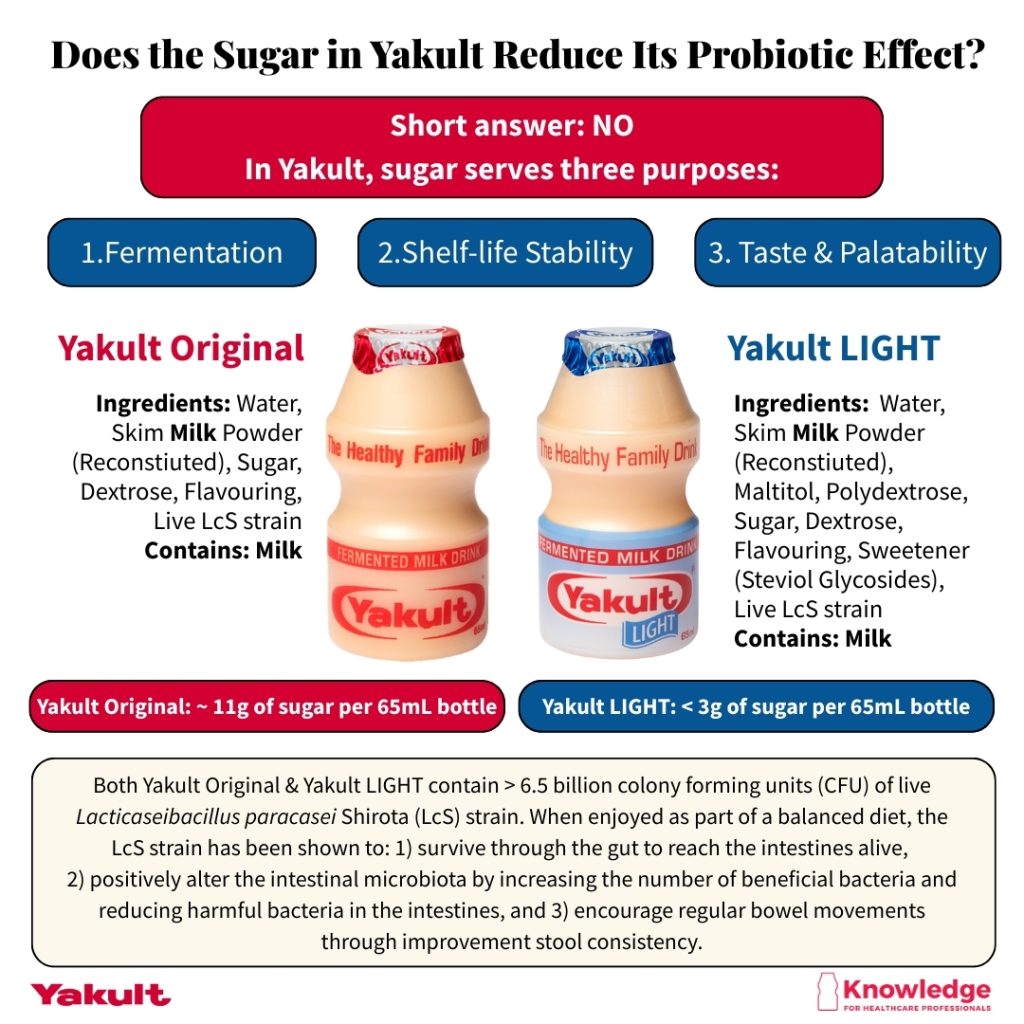
Yakult is a probiotic fermented milk drink containing the Lacticaseibacillus paracasei Shirota (LcS) strain. Each bottle contains at least 6.5 billion colony forming units (CFU) of live LcS at the end of its shelf life.
The LcS strain has been studied for more than 90 years, with research examining its survival through the gastrointestinal tract and its interactions with the gut microbiota. Findings from human studies suggest that the LcS strain can: 1-3
- Survive through the gut to reach the intestines alive
- Positively alter the intestinal microbiota by increasing the number of beneficial bacteria and reducing harmful bacteria in the intestines
- Encourage regular bowel movements through improved stool consistency
Despite this body of research, a common question raised by both health professionals and consumers is whether the sugar content in Yakult compromises or reduces its probiotic effect. This article explores that question critically, considering both microbiological evidence and broader nutritional context.
Understanding the Role of Sugar in Yakult
Sugar is an intentional component of Yakult’s formulation and plays several functional roles:
- Palatability: The fermentation process produces lactic acid, resulting in a naturally sour product. The addition of sugar helps balance acidity and improves acceptability for a broad range of consumers, including children and older adults.
- Fermentation and stability: During production, sugars act as an energy source for the probiotic bacteria. While not all added sugar is consumed during fermentation, its presence supports bacterial viability and consistency throughout the product’s shelf life.
From a product development perspective, sugar is therefore part of the system that allows probiotics to be delivered in a stable and consumable form.
Does Sugar Affect Probiotic Viability or Function?
Based on current evidence, there is no indication that the sugar present in Yakult reduces the viability or survival of the LcS strain.4 The probiotic bacteria are cultured, stored, and delivered in the presence of sugar, and bacteria counts are monitored through established quality control processes.
Manufacturing standards ensure that by the end of the 45-day shelf life, each bottle contains at least 6.5 billion live LcS strain. Sugar does not chemically or biologically inactivate the probiotic before ingestion, nor does it prevent the bacteria from surviving transit through the digestive tract. From a microbiological standpoint, the presence of sugar does not negate the probiotic effect of LcS strain.
Where the Critique Is Valid: Nutritional Context Matters
While sugar does not appear to reduce probiotic viability or function, the nutritional context in which probiotics are delivered remains important.
A bottle of Yakult Original contains approximately 11 g of sugar, while Yakult LIGHT contains less than 3 g of sugar. Through ongoing research and product development, understanding of the LcS strain has evolved, allowing for formulations with lower sugar content while maintaining bacterial viability and shelf life, as reflected in the development of Yakult LIGHT.
At the same time, Yakult Original continues to maintain its unique flavour and sweetness, consistent with Yakult’s origins and with formulations consumed globally.
When consumed at the intended serving size and frequency—one bottle per day—Yakult contributes a relatively small amount of energy within a typical dietary pattern. As with any food or beverage, its role is best considered alongside total dietary intake, lifestyle factors, and individual health needs.
Conclusion
Based on current evidence, the sugar present in Yakult does not reduce the viability or functional capacity of the LcS strain. The probiotic remains alive at the point of consumption and is able to survive passage through the digestive tract to exert its effects in the intestines.
As with all probiotic foods, Yakult is designed to be consumed in a defined serving size and frequency. When considered within the context of usual dietary intake, its nutritional contribution should be interpreted alongside overall diet quality and individual needs. From a microbiological standpoint, the presence of sugar does not negate the probiotic effect of LcS. From a nutrition perspective, context and balance remain central to informed dietary choices.
Further Professional Engagement
For healthcare professionals seeking a deeper understanding of the science behind the LcS strain, Yakult Dietitians provide a range of professional engagement opportunities designed to support ongoing education and evidence-based practice. These include guided factory visits and onsite educational sessions, available in both in-person and virtual formats, focusing on fermentation, quality control, and probiotic research.
A research booklet summarising key studies on the Lacticaseibacillus paracasei Shirota (LcS) strain is also available for those seeking further detail.
Enquiries regarding professional engagement or access to resources can be made via the contact form or by emailing admin@yakultknowledge.com.au.
References:
- Matsumoto K, Takada T, Shimizu K, et al. Effects of a probiotic fermented milk beverage containing Lactobacillus casei strain Shirota on defecation frequency, intestinal microbiota, and the intestinal environment of healthy individuals with soft stools. J Biosci Bioeng. 2010; 110(5):547-52. doi: 10.1016/j.jbiosc.2010.05.016
- Kato-Kataoka A, Nishida K, Takada M, et al. Fermented Milk Containing Lactobacillus casei Strain Shirota Preserves the Diversity of the Gut Microbiota and Relieves Abdominal Dysfunction in Healthy Medical Students Exposed to Academic Stress. Appl Environ Microbiol. 2016; 82(12):3649-58. doi: 10.1128/AEM.04134-15
- Sakai T, Makino H, Ishikawa E, et al. Fermented milk containing Lactobacillus casei strain Shirota reduces incidence of hard or lumpy stools in healthy population. Int J Food Sci Nutr. 2011; 62(4):423-30. doi: 10.3109/09637486.2010.542408
- Roselli M, Natella F, Zinno P, Guantario B, Canali R, Schifano E, et al. Colonization Ability and Impact on Human Gut Microbiota of Foodborne Microbes From Traditional or Probiotic-Added Fermented Foods: A Systematic Review. Frontiers in Nutrition. 2021;8:689084. doi: 10.3389/fnut.2021.689084