
Microbiome Testing & AI in Personalised Nutrition
As practitioners, our goal is to provide individualised nutrition advice for clients based on current guidelines and scientific evidence. Research into the gut microbiome, alongside advances in artificial intelligence (AI), is expanding our ability to understand why individuals respond differently to dietary interventions.(1,2)
While microbiome testing and AI are not yet integrated within routine dietetic practice, what if, one day, AI could help translate complex gut microbiome data into more precise, individualised nutrition recommendations?
In this blog, we explore the current evidence behind microbiome testing, consider the emerging role of AI, and discuss what this may mean for the future of personalised nutrition care.
The Role of the Gut Microbiome
The gut microbiome plays a multifaceted role in metabolism, digestion, immune function and host-microbe interactions.(2,3) It is a dynamic system, influenced by a range of modifiable factors such as dietary intake, medication use, sleep, stress, physical activity levels and environmental exposures.(2) Among these, dietary intake is considered a key modulator of microbial composition and metabolic processes.(4) There is growing evidence to suggest that differences in individual gut microbial profiles may explain inter-individual variability in responses to identical dietary interventions.(2,5) This has led to an increasing interest in whether microbial profiling could help inform individualised nutrition care.(6)
Microbiome Testing and Current Limitations
‘Microbiome testing’ refers to the use of sequencing technologies such as 16S rRNA gene sequencing and shotgun metagenomics to characterise microbial diversity, composition, abundance and functional potential.(2) Currently, there is no consensus on what defines a healthy microbiome.(7) Single-point testing has variable reliability due to the dynamic nature of the microbiome, which limits the ability to translate findings into long-term nutrition strategies.(2,7) These challenges have resulted in a limited availability of clinically validated microbiome tests. While microbiome testing can provide insights into individual microbiomes, results must be interpreted cautiously and considered alongside clinical reasoning and evidence-based guidelines.(7)
The Role of AI in Personalised Nutrition
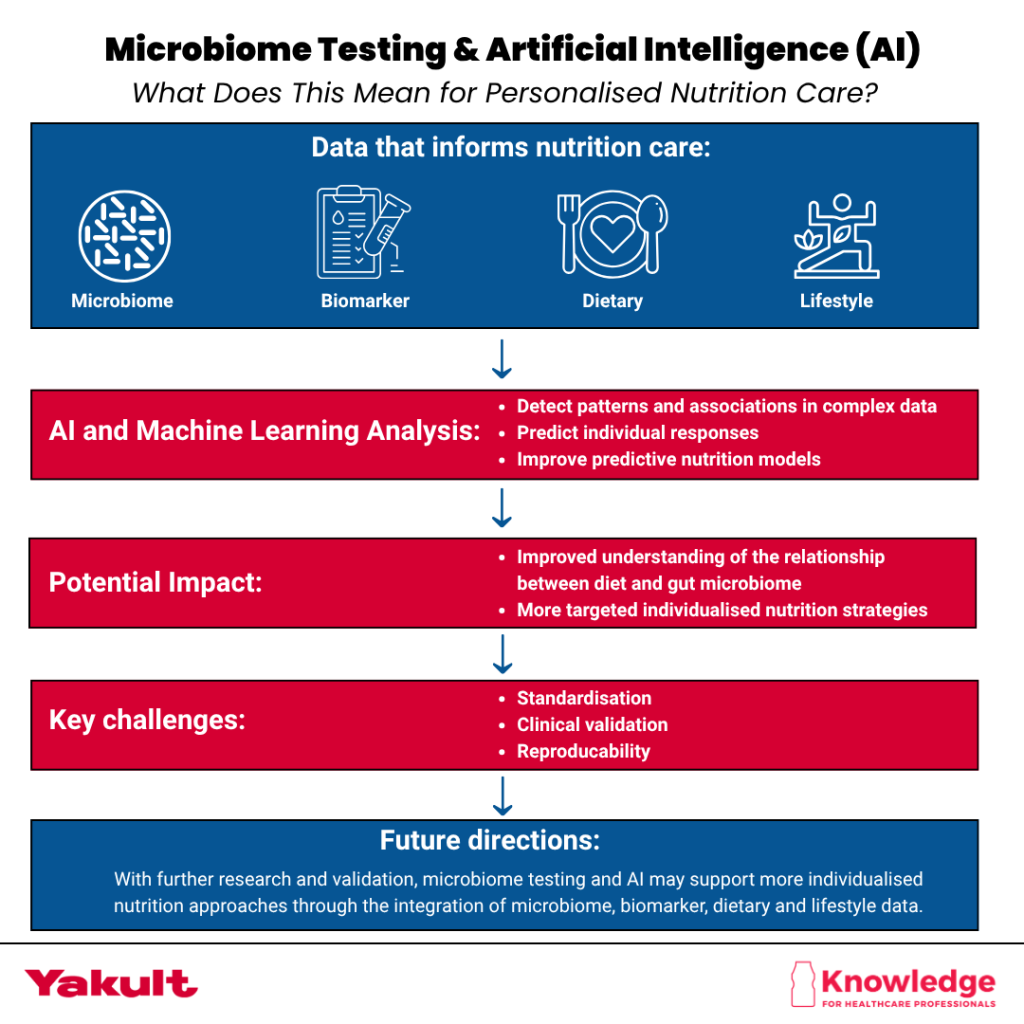
Given the complexity of microbiome datasets, there is increasing interest in the use of AI and machine learning to support their analysis. In this context, current research is exploring several potential applications of AI within personalised nutrition, including:
- Predicting postprandial glycaemic responses (8,9)
•Investigating inter-individual variability in dietary responses (2,9)
• Identifying associations between microbial patterns, dietary intake, and health outcomes (2)
• Developing personalised nutrition modelling (1)
More broadly, these technologies may help to:
- Identify relationships between diet and gut microbiome (2)
• Improve understanding of inter-individual dietary responses (2,9)
• Incorporate microbiome, biomarker and lifestyle data into nutrition care (8)
• Inform future individualised nutrition strategies (1)
Key studies have shown significant inter-individual variability in postprandial glycaemic responses to identical foods, suggesting that integrating microbiome data may improve predictive nutrition models.(8,9) However, further research is required to validate this approach across broader, more diverse populations and clinical settings before widespread implementation.
Future Directions in Individualised Nutrition Cares
In the future, microbiome testing and AI have the potential to further enhance individualised nutrition care through the incorporation of microbiome analysis and a better understanding of the relationship between diet, the gut microbiome, and host metabolism.(2,5) However, there are key challenges in ensuring standardisation and clinical validation, which require further research before this approach can be integrated into routine nutrition care.(7)
Currently, evidence-based nutrition strategies, involving dietary and lifestyle changes, remain the cornerstone of nutrition care, with microbiome testing and AI potentially used alongside this in the future to complement existing frameworks.(1)
References
- de Toro-Martín J, Arsenault BJ, Després JP, Vohl MC. Precision nutrition: A review of personalized nutritional approaches for the prevention and management of metabolic syndrome. Nutrients. 2022;14(9):1884. doi:10.3390/nu14091884
- Kolodziejczyk AA, Zheng D, Elinav E. Diet–microbiota interactions and personalized nutrition. Nat Rev Microbiol. 2019;17(12):742–753. doi:10.1038/s41579-019-0256-8
- Fan Y, Pedersen O. Gut microbiota in human metabolic health and disease. Nat Rev Microbiol. 2021;19(1):55–71. doi:10.1038/s41579-020-0433-9
- David LA, Maurice CF, Carmody RN, et al. Diet rapidly and reproducibly alters the human gut microbiome. Nature. 2014;505(7484):559–563. doi:10.1038/nature12820
- Visconti A, Le Roy CI, Rosa F, et al. Interplay between the human gut microbiome and host metabolism. Nat Commun. 2019;10:4505. doi:10.1038/s41467-019-12476-z
- Mullish BH, Marchesi JR, Thursz MR, et al. Microbiome-based therapies and personalised nutrition: Current evidence and future directions. Nat Rev Gastroenterol Hepatol. 2025;22:101–118.
- He Y, Wu W, Zheng HM, et al. Regional variation limits applications of healthy gut microbiome reference ranges and disease models. Nat Med. 2018;24(10):1532–1535. doi:10.1038/s41591-018-0164-x
- Zeevi D, Korem T, Zmora N, et al. Personalized nutrition by prediction of glycemic responses. Cell. 2015;163(5):1079–1094. doi:10.1016/j.cell.2015.11.001
- Berry SE, Valdes AM, Drew DA, et al. Human postprandial responses to food and potential for precision nutrition. Nat Med. 2020;26(6):964–973. doi:10.1038/s41591-020-0934-0
- Lavelle A, Sokol H. Gut microbiota-derived metabolites as key actors in inflammatory bowel disease. Nat Rev Gastroenterol Hepatol. 2020;17(4):223–237. doi:10.1038/s41575-019-0258-z