
What Is Gut Health?
Although the phrase “gut health” is ubiquitous in research, clinical practice, and consumer discourse, its meaning hasn’t always been clear or consistent. Only recently have experts attempted to formalise an evidence-based definition that can guide research, clinical care, and nutrition practice.
A New Scientific Consensus
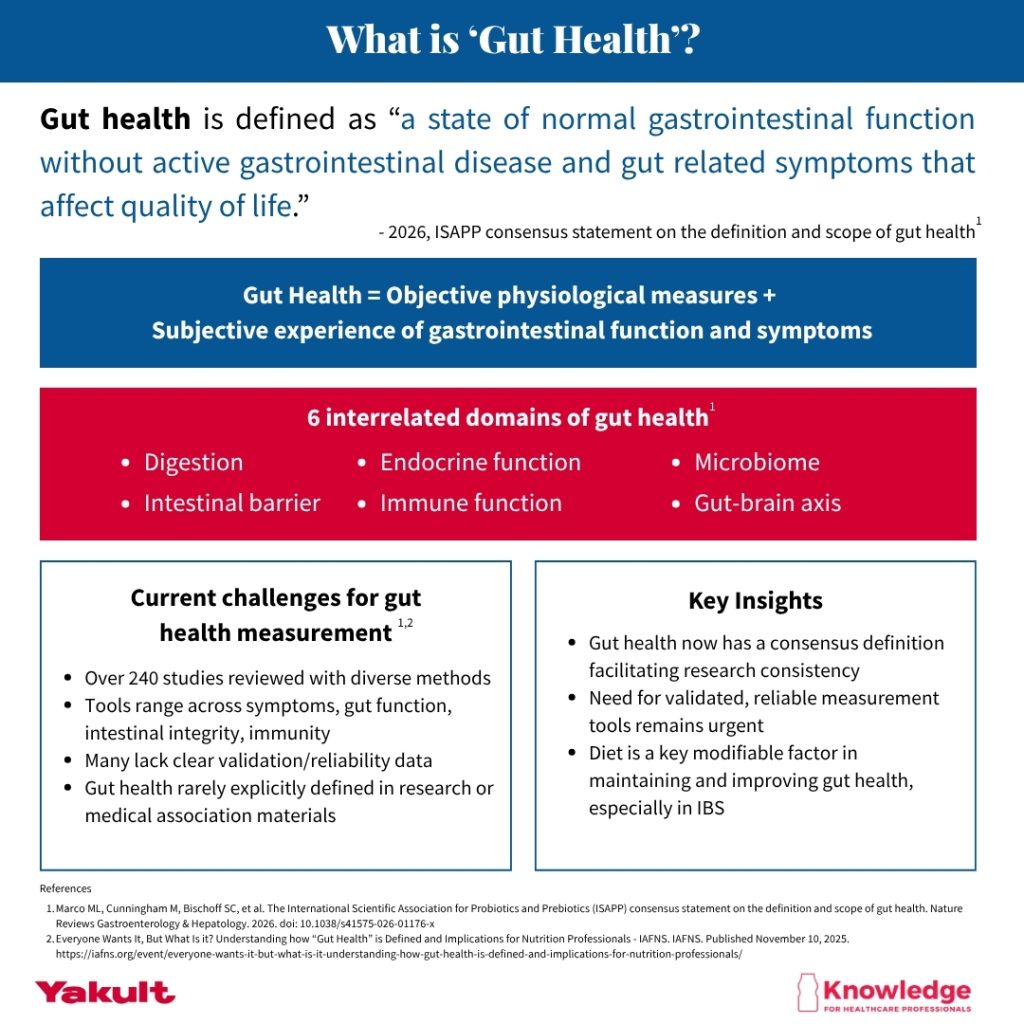
In February 2026, an international expert panel convened by the International Scientific Association for Probiotics and Prebiotics (ISAPP) published the first formal scientific definition of gut health in a consensus statement. According to this definition, gut health is:
“A state of normal gastrointestinal function without active gastrointestinal disease and gut related symptoms that affect quality of life.” 1
This definition is significant because it:
- Bridges physiology and experience: It acknowledges both functional processes (e.g., digestion, motility) and how people feel day to day.
- Applies to healthy and chronic disease states: A person with a chronic GI condition can still have “gut health” if disease is controlled and symptoms do not impact quality of life.
The Six Domains of Gut Health
The consensus framework identifies six interrelated physiological domains that collectively contribute to gut health: 1
- Digestion — Effective breakdown and absorption of nutrients
- Endocrine function — Hormonal signalling relevant to appetite, motility, and metabolism
- Microbiome — Composition, diversity, and metabolic activity of gut microbes
- Intestinal barrier — Integrity of the gut lining and protection against pathogens
- Immune function — Local and systemic immune responses regulated in the gut
- Gut‑brain axis — bidirectional communication between the gut and central nervous system
Practical implications for Dietitians and Health Professionals
- Diet as a Core Driver of Gut Health
- Diet shapes both gut physiology and microbial activity, influencing digestion, barrier integrity, immune responses, and the gut-brain axis. 1
- High-fibre, plant-rich diets and fermented foods are consistently associated with supporting microbial diversity and maintaining intestinal barrier function.2
- Dietitians surveyed in recent research (unpublished, during the 2025 ISAPP panel discussion) use a wide variety of dietary approaches tailored to individual patients, including:3
- Mediterranean diet
- Low FODMAP diet
- British Dietetic Association (BDA) NICE diet
- Fibre and probiotic supplementation
- Mindful and regular eating behaviours
- This diversity reflects the multifaceted nature of gut health and the need to customise interventions based on patient symptoms, preferences, and clinical contexts.
- Assessment Strategies: Challenges and Approaches
- Measuring gut health remains complex due to the lack of a single, standardised metric.1
- A combined assessment approach is recommended, integrating:1
- Subjective symptom evaluation: Using validated questionnaires such as the Gastrointestinal Symptom Rating Scale, IBS Symptom Scoring System (IBS-SSS), visual analogue scales, and symptom-specific tools.
- Objective physiological markers: Including tests of gastric motility, intestinal barrier integrity (e.g., zonulin, lactulose/mannitol ratio), and immune biomarkers (e.g., calprotectin, cytokines).
- Many existing tools were developed primarily for pathological states and may lack validation for measuring gut health in healthy or remission states.
- Dietitians should be aware of the interindividual variability in symptom thresholds and consider longitudinal monitoring to capture meaningful changes.3
- For conditions like Irritable Bowel Syndrome (IBS), symptom severity and quality of life impact remain the primary clinical markers, as no definitive objective biomarkers currently exist for diagnosis or monitoring.
- Dietary Management in Clinical Practice: The Case of IBS
- IBS exemplifies the complexity of gut health, involving altered bowel habits, abdominal pain, and gut-brain axis dysregulation.
- Dietary approaches with evidence of efficacy include:3
- Low FODMAP diet: Restricts fermentable carbohydrates to reduce symptoms like bloating and gas; effective in approximately 60% of patients in clinical trials.4
- BDA NICE diet: Emphasises regular eating patterns, balanced fibre intake, and symptom-specific modifications; practical and accessible with 40–50% response rates.5
- Mediterranean diet: Emerging evidence suggests benefits for gut symptoms and mood, even though it includes foods high in FODMAPs; may act through microbiome modulation and inflammation reduction.6
- Dietitians play a critical role in tailoring these diets, guiding reintroduction phases, and supporting long-term adherence and personalisation.
- Integration of psychological and medical management alongside dietary care is important for holistic patient outcomes.
Conclusion
For dietitians and health professionals, the evolving consensus on gut health highlights the importance of:
- Recognising gut health as a multifaceted, dynamic state encompassing physiology, symptoms, and quality of life.
- Applying a holistic assessment strategy that combines subjective symptom evaluation with objective functional measures where possible.
- Emphasising diet as a modifiable determinant with diverse evidence-based approaches tailored to individual patient needs.
- Supporting ongoing research and professional education to refine measurement tools and dietary interventions for optimal gut health outcomes.
References:
- Marco ML, Cunningham M, Bischoff SC, et al. The International Scientific Association for Probiotics and Prebiotics (ISAPP) consensus statement on the definition and scope of gut health. Nature Reviews Gastroenterology & Hepatology. 2026. doi: 10.1038/s41575-026-01176-x
- Li F, Armet AM, Korpela K, et al. Cardiometabolic benefits of a non-industrialized-type diet are linked to gut microbiome modulation. Cell. 2025. 6;188(5):1226-1247.e18. doi: 10.1016/j.cell.2024.12.034
- Everyone Wants It, But What Is it? Understanding how “Gut Health” is Defined and Implications for Nutrition Professionals – IAFNS. IAFNS. Published November 10, 2025. Accessed March 19, 2026. https://iafns.org/event/everyone-wants-it-but-what-is-it-understanding-how-gut-health-is-defined-and-implications-for-nutrition-professionals/
- Staudacher HM, Whelan K. The low FODMAP diet: recent advances in understanding its mechanisms and efficacy in IBS. Gut. 2017;66(8):1517-1527. doi: 10.1136/gutjnl-2017-313750
- National Institute for Health and Clinical Excellence. Irritable bowel syndrome in adults. Diagnosis and management of irritable bowel syndrome in primary care. Clinical guideline 61. Published February 23, 2025. Accessed March 19, 2026. https://www.nice.org.uk/Guidance/CG61
- Staudacher HM, Mahoney S, Kim Ek Canale, et al. Clinical trial: A Mediterranean diet is feasible and improves gastrointestinal and psychological symptoms in irritable bowel syndrome. Alimentary Pharmacology & Therapeutics. 2023;59(4). doi:https://doi.org/10.1111/apt.17791